Two ropes of the same diameter, same steel, same breaking load on the certificate. One of them is still working after four years in a mine shaft. The other is a pile of broken wires on the drum. The difference is not the steel.
A compacted strand wire rope is a rope in which the individual wires in each strand are mechanically compressed after the rope is formed. This increases the wire cross-sectional density and reduces internal voids, so the rope is stronger, more durable, and more resistant to wear and fatigue than a conventional rope of the same diameter. Our popular constructions are 15XK7, 35WXK7, 24WXK7, and 18XK7-FC.
Compaction is a manufacturing change, not a material change. It costs a little more at the factory and it pays for itself in the rope life. Here is what it actually does.
What Is Compacted Strand Wire Rope?
A compacted rope has slightly flattened wires instead of round ones.
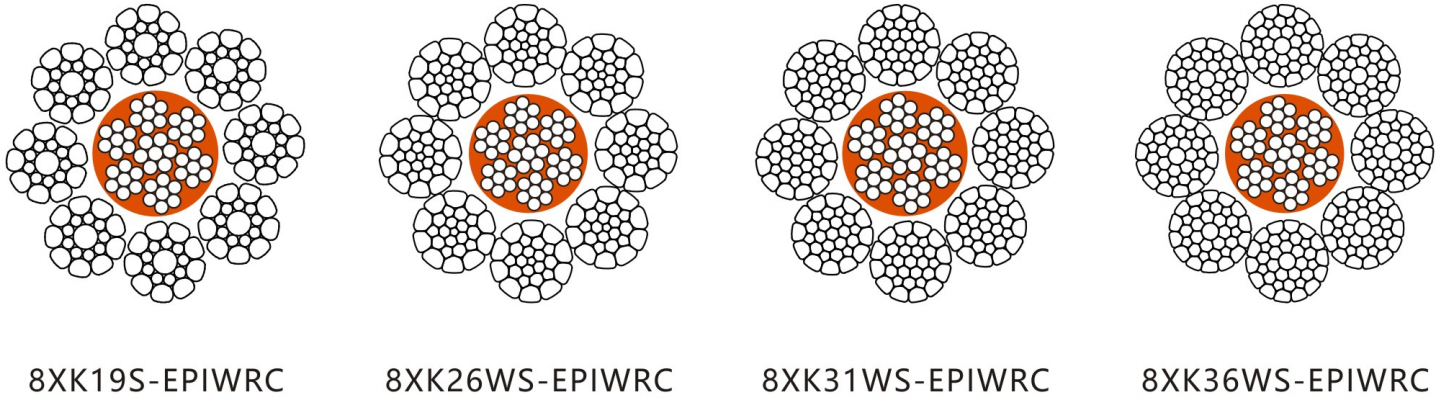
In a standard wire rope, every wire keeps its natural circular cross-section. In a compacted rope, the wires in each strand are squeezed together mechanically after the rope has been formed. The wires come out slightly flattened. Because they are flattened, they pack against each other more tightly, and the rope ends up with more metal in the same diameter and fewer empty spaces between the wires.

What Does the Compaction Process Actually Do?
After the rope is strung, each strand passes through a compaction stage. The strand is squeezed in one dimension so the wires deform slightly and fill the gaps. The rope is then closed up to the correct diameter. The result is a strand with a higher metal content than a conventional strand of the same nominal size.
What Is the Difference Between Compacted and Round Strand?
This is the single most common question we get about wire ropes, and the answer comes down to three things: how much metal is in the rope, how the metal is distributed, and what happens to the voids between the wires.
| Factor | Compacted Strand | Round Strand |
|---|---|---|
| Wire cross-section | Slightly flattened | Natural circular |
| Metal content | Higher at the same diameter | Lower at the same diameter |
| Internal voids | Reduced, better packed | Present between the wires |
| Load sharing | More even across the section | Concentrated at the contact points |
| Abrasion resistance | Better | Good |
| Fatigue resistance | Better | Standard |
| Cross-section area | Larger at the same diameter | Smaller at the same diameter |
| Manufacturing cost | Higher | Lower |
| Typical use | Deep mine hoisting, high-cycle lifting | General lifting, cranes, marine |
A useful way to think about it: a compacted rope of 40 mm diameter contains more steel than a round strand rope of 40 mm diameter. It is not a different steel. It is more of the same steel, packed tighter.
How Is Compacted Strand Wire Rope Constructed?
Four elements decide the specification.
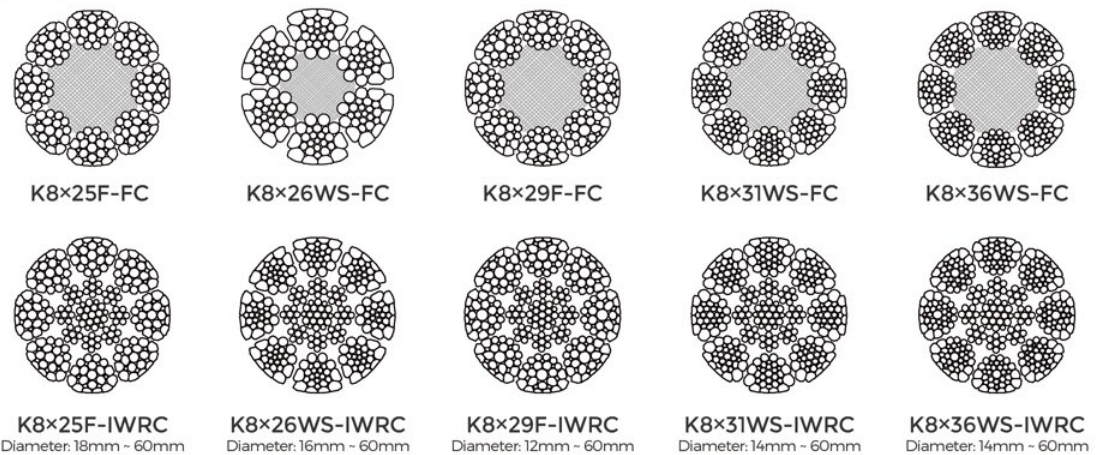
The core type comes first. A fiber core gives flexibility but lower strength and lower abrasion resistance. An independent wire rope core, IWRC, adds strength, stiffness, and resistance to crushing. The strand configuration can be 6×19, 6×36, or 8×19 depending on the application, and the compaction process increases the metal content per strand. The material can be carbon steel for standard work, galvanized steel for outdoor or marine exposure, or stainless steel for highly corrosive environments.
| Element | Options | What It Changes |
|---|---|---|
| Core type | Fiber core (FC) or IWRC | FC = flexible; IWRC = strong and crush resistant |
| Strand configuration | 6×19, 6×36, 8×19 | 6×19 = tough; 6×36 = flexible; 8×19 = heavy duty |
| Material | Carbon, galvanized, stainless steel | Corrosion resistance and cost |
| Compaction | Mechanical after forming | Raises metal content, reduces voids |
How Do You Choose Between a Fiber Core and an IWRC?
The fiber core is the traditional choice. It gives the rope more flexibility, which matters when the rope works over a small drum or has to wrap tight around sheaves. The IWRC is a bundle of stranded wires in the middle of the rope. It makes the rope stiffer and stronger, and it resists being crushed. On a deep mine hoist, where the rope runs under high tension and gets crushed against the drum, the IWRC is the better answer.
The trade-off is straightforward. If your application is high-cycle lifting with frequent direction changes, the fiber core is usually better. If the rope is static, heavy, or running on a large drum, the IWRC wins.
How Do the Strand Configurations Differ?
6×19 has fewer wires per strand and a larger wire diameter. This makes it tough and abrasion resistant, and it is the classic choice for heavy lifting and rough conditions. 6×36 has more, smaller wires, which gives much better fatigue resistance and flexibility. 8×19 has eight strands and is used where a larger rope is needed at a given strength.
The rule of thumb: 6×19 for abrasion and shock, 6×36 for fatigue and repeated bending, 8×19 when you need more load in a bigger rope. And when the rope has to be non-rotating, our non-rotating wire rope range uses a different balancing arrangement entirely.
What Do You Gain From Compacted Strand Construction?
Four practical benefits on the job.
Higher breaking strength at the same diameter, because there is more metal in the section. Better fatigue resistance, because the load is distributed more evenly across the compacted section. Better wear resistance, because the reduced voids mean less room for grit and water to work into the rope. And a longer service life overall, which reduces the number of rope changes over the life of the installation.
Why Does More Metal Mean More Strength?
Breaking load is a function of the metal cross-sectional area and the wire tensile strength. Compaction does not change the tensile strength of the steel. It increases the area. So the same diameter rope now carries more load before it fails.
This is why a compacted rope is often the cheaper answer even when the unit price is higher. If you can specify a smaller diameter rope for the same working load, you are buying less rope, less drum space, and a lighter reeving arrangement. On a big hoist, that difference is often worth more than the rope cost itself.
Why Does Compaction Improve Fatigue Resistance?
Fatigue failure starts where the stress is highest and repeated. In a round strand rope, the contact between adjacent wires is a point contact, and the stress concentrates there. Each cycle over a sheave works that point. In a compacted rope the contact is spread over a wider area because the wires are flattened and pressed together. The stress concentration is lower, and the rope survives more cycles before a wire breaks.
This is the benefit that matters most on a rope that runs over sheaves every hour of every day. A compacted rope that sees high cycle counts will outlast a conventional rope of the same diameter by a wide margin.
Why Does Reduced Void Matter in a Wet Environment?
Every gap between wires is a place where water sits and where grit can work its way in. In a compacted rope there are fewer gaps and they are smaller. Water penetrates less, corrosion starts later, and the grit that gets in does less damage because there is less room for it to move. This is the reason compacted rope is specified for mine shafts, marine work, and any application with a wet or aggressive environment.
How Do You Choose the Right Compacted Wire Rope?
Five questions in this order.
Start with the working load and the required safety factor. Then look at the cycle count, because that decides between 6×19 and 6×36. Then the environment, which decides carbon versus galvanized versus stainless and whether the core needs to be sealed. Then the drum and sheave geometry, because the minimum sheave diameter depends on the construction. And finally the specification: state the compacted construction by name, not just the diameter.
- Working load, breaking load, and the required safety factor
- Number of bending cycles per day, and whether the rope runs on sheaves
- Environment: dry, wet, marine, or aggressive
- Drum and sheave dimensions, to check the minimum sheave diameter
- Whether corrosion protection is needed, and whether the core is sealed
What Are the Popular Compacted Constructions?
Our popular compacted constructions are 15XK7, 35WXK7, 24WXK7, and 18XK7-FC. The 15XK7 and 35WXK7 are the workhorses for hoisting and general heavy lifting. The 24WXK7 offers higher breaking strength in a given diameter. The 18XK7-FC is the fiber core version for applications where flexibility matters more than crush resistance.
| Construction | Core | Best For | Key Point |
|---|---|---|---|
| 15XK7 | Wire | General hoisting and lifting | Good all-round compacted construction |
| 35WXK7 | Wire | Heavy duty and high-cycle work | High strength, good fatigue resistance |
| 24WXK7 | Wire | Maximum strength at a given diameter | Compact form factor |
| 18XK7-FC | Fiber | Applications needing flexibility | FC core, softer running |
Why Should You State the Compaction in the Specification?
Because a compacted rope and a conventional rope of the same nominal size do not have the same breaking load. If the specification only says the diameter and the construction, the supplier can legally supply the conventional rope, and the certificate will show a lower number than you designed for. Write the specification as compacted 35WXK7, not as 35WXK7. This is the most common mistake I see in rope enquiries, and it is expensive.
How Does This Compare With Shaped Strand Rope?
Both approaches improve on a round strand rope, and they work in slightly different ways. Compaction flattens the wires within a strand. Shaped strand flattens the strand itself, which is what our shaped strand wire rope range does. Shaped strand gives better contact between strands and lower internal friction. Compaction gives higher metal content within the strand. They can also be combined.
How Do You Maintain a Compacted Wire Rope?
The same discipline as any rope, with one extra point.
Inspect the rope regularly for broken wires, birdcaging, and core protrusion. Lubricate on the schedule the manufacturer specifies. Check the drum and sheaves for wear, because a rope running on a worn sheave will fail regardless of how good the rope is. And when you record a rope change, record the construction too, so the history stays accurate.
What Does the Extra Compaction Change About Inspection?
In practice, little. The inspection points are the same. What does change is the interpretation. Because the wires are flattened and packed tight, the visible gap between wires is smaller, so a broken wire may not stand out as much as it would on a round strand rope. Look carefully at the rope surface, and treat any wire protrusion or local opening of the strand as a reason to examine the rope properly rather than just running it.
When Should a Compacted Rope Be Replaced?
Replace it when the number of broken wires in one rope lay reaches the discard criteria in the applicable standard, when the rope shows significant corrosion, when there is any birdcaging or core protrusion, or when the rope has been overloaded. Do not try to judge a compacted rope by how it looks on the outside alone. A compacted rope can look good and still have internal damage, which is one of the arguments for keeping good records from the day the rope goes on.
Conclusion
A compacted strand wire rope has mechanically flattened wires, so it carries more metal at the same diameter, with fewer internal voids. That means more strength, better fatigue and wear resistance, and a longer life. Specify it by name, 15XK7, 35WXK7, 24WXK7, or 18XK7-FC, and choose the core and the strand configuration for the cycle count and the environment.