A dragline rope lasts two years. Not because of the steel, but because the outside of the rope is being destroyed by rock and spoil. Wrap that rope in a polymer jacket and the problem moves from the rope to the jacket, which is a much easier problem to solve.
Plastic coated wire rope is a specialized wire rope designed to combine the high strength and durability of steel with the protective benefits of a plastic coating. In heavy-duty mining applications, such as draglines, shovels, and underground coal mining, these ropes are particularly valued for their resistance to abrasion, corrosion, and environmental hazards, ensuring safe and long-lasting operation.
The coating is an extruded polymer layer around the finished rope. It is a different answer from the one plastic impregnation gives, and the difference matters when you are choosing.
What Is Plastic Coated Wire Rope?
A coated rope has an extruded polymer jacket over the steel.
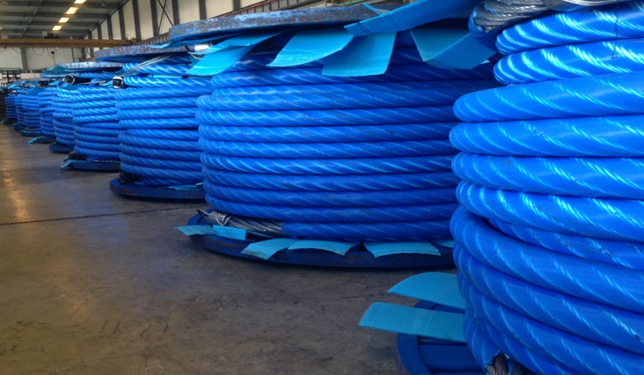
The rope is built first, in the same way as any other wire rope, and then an extruded polymer layer is applied around the outside. The result is a rope with a coloured, smooth outer surface. The jacket can be made in different colours and different polymers, which means the rope can be identified by eye at a glance on a busy site.
What Does the Coating Actually Protect Against?
The coating is a sacrificial layer. It absorbs the abrasion that would otherwise be taking metal off the wires, and it seals the rope against water and chemicals. When the jacket finally wears through, the steel underneath is still intact. The rope gets a warning, and the operator can plan a change rather than discovering a failure.
| Protection Type | What It Resists | Where It Acts | Failure Pattern |
|---|---|---|---|
| Abrasion | Rock, grit, and spoil cutting the rope | Outer surface | Jacket wears, steel survives |
| Corrosion | Water, salt, and chemicals | Outer surface | Jacket degrades, steel survives |
| Chemical attack | Acids, alkalis, and aggressive fluids | Outer surface | Jacket degrades, steel survives |
| Internal corrosion | Water inside the strands | Not directly addressed | Use PI rope instead |
What Are the Coating Materials?
The polymer is chosen for the environment. PVC and polyurethane are the common choices. PVC is hard and abrasion resistant, and it resists most oils and chemicals. Polyurethane is more flexible and has better resistance to abrasion and wear at the flex points, which is why it is often used on ropes with high cycle counts.
The colour is not decorative. Different colours identify different rope types on site, and this matters on a dragline or a shovel where several ropes run in the same area and the wrong one gets handled.
Where Is Plastic Coated Wire Rope Used?
The mining sector is where coated rope earns its place.
In heavy-duty mining applications, such as draglines, shovels, and underground coal mining, these ropes are particularly valued for their resistance to abrasion, corrosion, and environmental hazards. The dragline digs rope is dragged over broken rock and spoil continuously. The shovel hoist rope works on high-cycle service. Underground coal has water, and often acidic water.
| Application | Main Wear Mechanism | Why Coated Rope Helps |
|---|---|---|
| Dragline digging rope | Abrasion from rock and spoil | The jacket takes the wear instead of the wires |
| Shovel hoist rope | High cycle service | Jacket reduces scuffing between rope and sheave |
| Underground coal mining | Water, corrosion, and abrasion | Seals the rope against moisture |
| Truck and shovel loading | Abrasion and impact | Protects against stray rock damage |
| Marine and coastal | Salt and continuous wet | Jacket isolates the steel from the salt |
| Chemical plant handling | Aggressive fluids | Jacket resists the chemical that would attack steel |
Why Do Draglines Need Coated Rope So Badly?
A dragline digging rope is dragged along the ground for the length of the cut. It works through broken rock, and it works through the spoil it has just excavated. This is the most abrasive duty any wire rope sees. The wires at the surface of the rope take the cutting, and they get thinner and weaker until they break.
A polymer jacket takes this instead. The jacket is softer than the steel, so it wears down gradually and distributes the damage across the whole circumference rather than concentrating it on the outermost wires. The rope stays at full section, so the breaking load stays at the certificate value for much longer.
Is Coated Rope Used Outside Mining?
Yes. Marine and coastal lifting, chemical plant material handling, and offshore crane work all use coated rope. The common factor is not the industry, it is the combination of abrasion and corrosion in the same place. Where you have one of those alone, other treatments can be cheaper. Where you have both, the jacket is the efficient answer.
How Does a Coated Rope Compare With a PI Rope?
They protect different places on the rope.
A coated rope has an extruded polymer jacket around the outside. A PI rope has polymer compound injected between the wires inside the strands. One is an external armour, the other is an internal seal.
| Factor | Plastic Coated | Plastic Impregnated |
|---|---|---|
| Polymer position | Extruded jacket on the outside | Compound between the wires |
| External abrasion | Excellent | Limited |
| External corrosion | Excellent | Limited |
| Internal corrosion | Not directly addressed | Excellent |
| Internal friction | Slightly reduced | Reduced |
| Flexibility | Slightly stiffened | Maintained |
| Appearance | Coloured jacket, easy to identify | Steel look, smooth |
| Typical use | Draglines, shovels, marine, chemical | Mine hoists, wet environments, high cycle |
Can You Have Both?
Yes. A rope can be both impregnated internally and coated externally. This is the correct answer for a severe environment where both external abrasion and internal corrosion are problems, such as a dragline working in wet ground. It costs more than either treatment alone, and it is sometimes the only way to get the rope life the duty needs.
What About Galvanizing as an Alternative?
Galvanizing protects the steel from corrosion but does nothing for abrasion. In a dragline, the abrasion is what kills the rope, so galvanizing alone is not enough. In a wet mine hoist where corrosion is the problem and the wear is light, galvanizing or PI rope may be the better answer. The deciding question is always which mechanism is actually destroying the rope.
How Does a Coated Rope Compare With a Spiral Strand Rope?
These two solve completely different problems, and the comparison comes up because both are used in heavy lifting. A coated rope is a conventional flexible rope with an external armour. A spiral strand rope is a completely different construction, made of individual round wires helically wound around a core in opposing directions, giving very high axial stiffness and a torque-balanced design.
The coated rope bends. It goes over sheaves, around drums, and through the cycle changes that lifting equipment demands. The spiral strand rope wants to stay straight. It is built for high axial load over a long length, where bending is not wanted. Our spiral strand ropes page covers that construction in detail.
The practical summary: if the rope bends around a sheave every cycle, choose a round strand construction and protect it with coating or impregnation. If the rope is a straight tension member that stays straight, choose a spiral strand.
What About the Rope Termination on a Coated Rope?
The termination has to suit the coated rope, not the bare rope. The standard mechanical terminations are made for steel, and the jacket has to be stripped back from the socket area so the wedge or the drum seats properly on the steel. If the jacket is left in the socket, the termination is weaker than the rope and it can pull out.
This means the stripping length has to be specified and has to be done correctly, and the termination has to be rated for the coated rope’s diameter and breaking load. Our swaged wire rope page covers the mechanical termination options in detail, including the swaging and socket methods that are used on coated rope.
How Do You Choose Between a Coated Rope and a Galvanized Rope?
The question is which damage mechanism is actually destroying the rope. Galvanizing coats the steel with a zinc layer. It protects against corrosion effectively, and it does nothing for abrasion. A plastic jacket takes abrasion and corrosion together.
In a wet shaft with light wear, galvanized steel is often the right answer, because it costs less than a jacket and it solves the problem that exists. On a dragline where the rope drags over rock, the abrasion is the killer, and a galvanized rope will still be cut through by the rock. The jacket is the only treatment that addresses it.
There is a third option worth knowing. Some ropes are made with galvanized wires and then coated, which gives corrosion protection in the steel and abrasion protection on the outside. This is the most complete answer for a severe environment, and it is worth specifying when the duty is severe enough to justify it.
What Temperature Range Does a Coated Rope Work In?
This is a specification question that comes up more often than it should, because a coated rope is a polymer product as much as it is a steel product. The compound has a working temperature range, and outside it the polymer gets soft, gets brittle, or degrades.
Polyurethane coatings generally handle a wider temperature range than PVC, which is one of the reasons to choose polyurethane on a dragline working in cold conditions. For any installation with an extreme temperature, the compound specification has to be checked against the working conditions and not assumed. The same applies to chemical exposure, where the polymer has to be matched to the specific agent.
How Do You Handle and Inspect a Coated Rope?
The jacket changes how you inspect the rope.
You cannot see the wires the way you can on a bare rope. The jacket hides them. So the inspection has to be different. Look at the jacket itself. Check for cuts, tears, thinning, cracking, or a change of colour where the compound has degraded. Look for the jacket lifting or separating from the rope. And look at the ends, where the jacket is cut and the steel is exposed.
| What to Check | What It Means | Action |
|---|---|---|
| Cuts or tears in the jacket | The steel underneath is exposed | Replace the rope |
| Thinning or worn-through areas | The armour is gone, steel is at risk | Replace the rope |
| Cracking or chalking of the compound | The compound has degraded | Assess, likely replace |
| Jacket lifting or separating | Water can get behind the jacket | Replace the rope |
| Corrosion visible at the cut ends | The steel is being attacked | Replace, and check the environment |
| Uneven wear pattern | Possible poor spooling or sheave issue | Check the drum and sheaves first |
What Happens When the Jacket Wears Through?
This is the good news about coated rope. The jacket is designed to be sacrificial. It wears gradually, and when it finally breaks through, the steel underneath is still at full section. The rope has lost its external protection but it has not lost its strength. In practice this means the operator finds the worn jacket during a routine inspection and changes the rope while it is still safe.
The danger is a rope that is inspected by looking only at the steel. If the operator cannot see the wires, they cannot count the broken wires. Judge a coated rope by its jacket condition, not by what you think is underneath.
Does the Coating Affect the Minimum Sheave Diameter?
Slightly, and this is a real consideration. The jacket adds to the effective diameter and stiffens the rope marginally, so the practical minimum sheave diameter for a coated rope is a little larger than for the same bare construction. On a crane with small sheaves this can decide whether the rope fits at all. Check the sheave diameter against the coated rope specification, not the bare rope specification.
Conclusion
Plastic coated wire rope carries an extruded polymer jacket that protects the steel from abrasion, corrosion, and chemicals. It is the standard choice for draglines, shovels, and underground coal mining, where the outside of the rope takes the damage. Inspect the jacket rather than the wires, because the jacket is what you can actually see.