A rope goes into a wet shaft. The water gets inside. Six months later the wires inside the strands are rusted through, and the rope fails on the drum. Nobody saw it happening.
Plastic impregnated wire rope, often abbreviated as PI wire rope, is an advanced type of wire rope designed to offer superior performance in harsh working environments. By combining high-strength steel wires with plastic impregnation, this rope achieves excellent resistance to corrosion, wear, and fatigue while maintaining high flexibility and load-bearing capacity. Our popular constructions are 16XK7-EP and 35WXK7-EP.
The idea is simple. If you fill the gaps between the wires with a polymer, the water cannot get in, and the wires cannot rub against each other. Both of the most common rope killers are removed in one operation.
What Is Plastic Impregnated Wire Rope?
A PI rope has polymer compound pressed into the gaps between the wires.
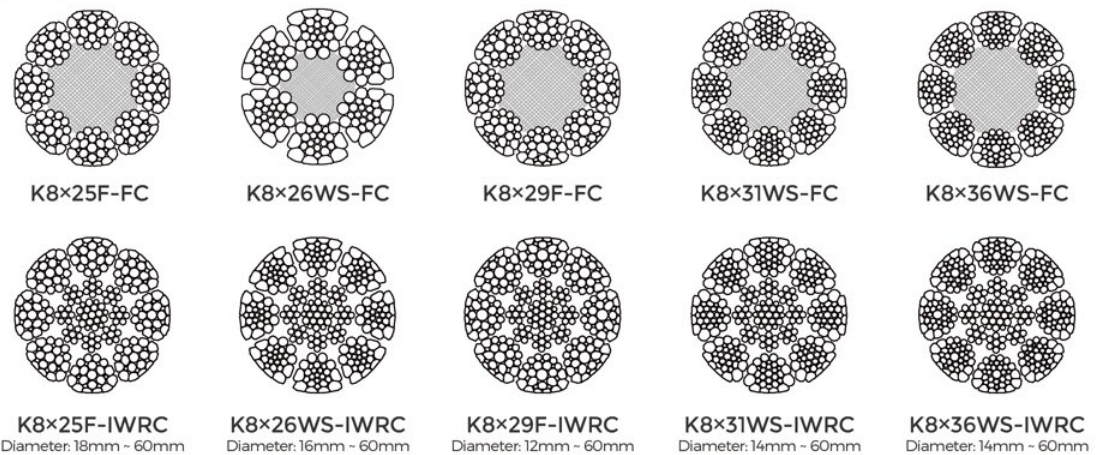
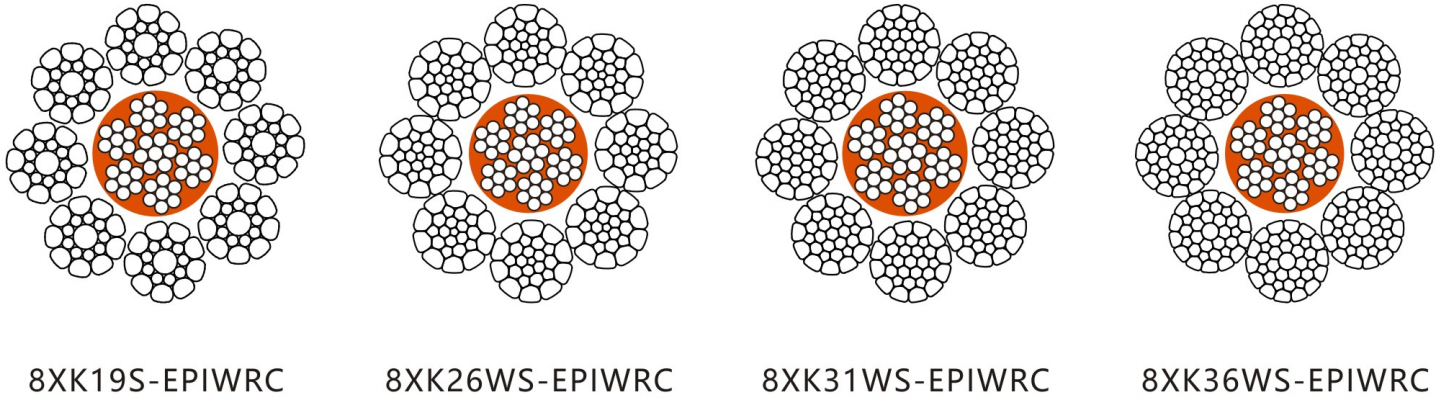
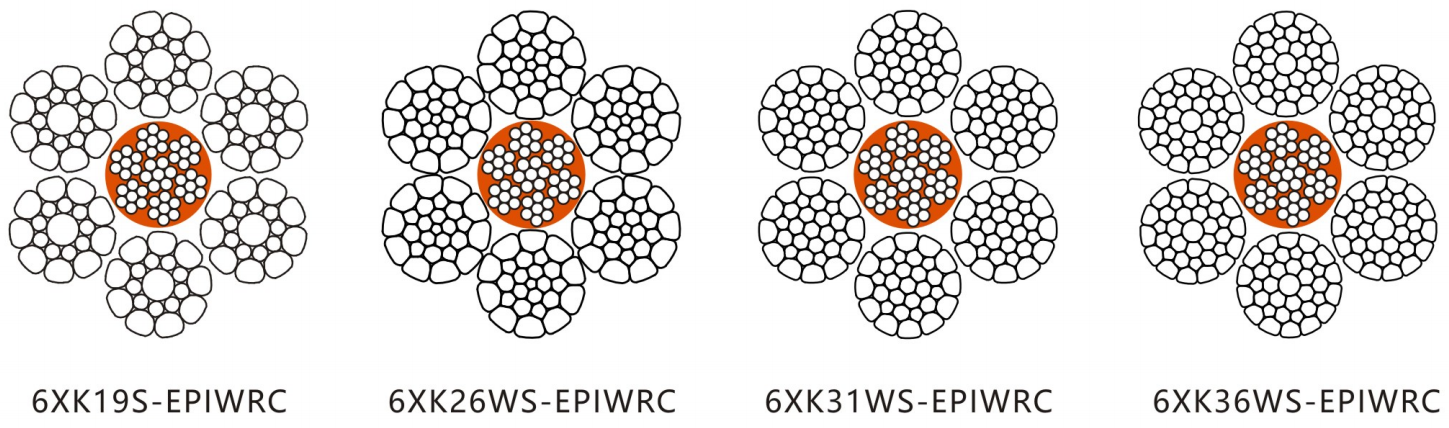
Plastic impregnated wire rope is constructed by filling the spaces between the individual wires in the strands with a specialized plastic compound. The rope generally consists of three parts. The core is usually made from fiber, such as polypropylene or natural fiber, or from steel wire to provide additional strength and shape retention. The strands are composed of high-quality carbon or alloy steel wires, twisted together to form a round or shaped cross-section. The plastic impregnation itself is a thermoplastic or polymer material injected under pressure, filling the gaps between wires and strands to prevent internal corrosion and reduce friction.
How Does the Impregnation Get Into the Rope?
The rope is built first, and then the compound is injected under pressure into the finished strands. The compound flows into the voids between the wires. It does not coat the wires, it fills the space around them. This is the important distinction with plastic coated wire rope, where the polymer sits on the outside of the rope as an extruded sleeve.
| Factor | Plastic Impregnated | Plastic Coated |
|---|---|---|
| Where the polymer goes | Inside, between the wires | Outside, as an extruded sleeve |
| Method | Injected under pressure | Extruded jacket over the rope |
| Protects against internal corrosion | Yes, directly | Indirectly |
| Protects against external abrasion | Limited | Yes, directly |
| Effect on flexibility | Maintained | Slightly reduced |
| Visual appearance | Steel look, smooth surface | Coloured jacket, clearly identifiable |
| Best for | Wet, internal corrosion risk | Abrasion, chemical exposure |
What Does the Core Look Like in a PI Rope?
A fiber core, commonly polypropylene or natural fiber, gives the rope flexibility and shape retention. A steel wire core gives more strength. The choice is the same one you make with an untreated rope, and the impregnation does not change it. What the impregnation does is protect whatever is inside the strands, which is exactly where an untreated rope fails first in a wet environment.
What Does Plastic Impregnation Actually Buy You?
Four benefits, and the first one is the big one.
Excellent resistance to internal corrosion. Reduced internal friction. Better wear resistance. And a longer service life, because the mechanical properties are maintained over a much longer period than a conventional rope in the same conditions.
Why Is Internal Corrosion the First Thing to Address?
This is worth explaining clearly, because it drives the whole decision to use PI rope. On an untreated rope in a wet environment, water enters the strands through the open ends of the rope and through the gaps between the wires. Once inside, it sits there. It cannot dry out because it is held in the voids by the wire geometry. It corrodes the wires from the inside.
Here is the problem: the outside of the rope looks perfect. The breaking load drops, the wires lose section where you cannot see it, and the rope eventually fails without any visible warning at the surface. By the time the operator notices broken wires at the drum, the internal damage has been developing for months. Impregnation closes the voids, so the water never gets in, and the internal condition stays the same as the external condition.
How Does Impregnation Reduce Friction?
The compound fills the voids between the wires, so the wires no longer rub directly against each other. The friction between wires drops, and with it the internal wear that is the main mechanism of failure in a high cycle rope. This is the same benefit that shaped strand rope delivers through geometry, achieved here through material.
This matters most on ropes that work over sheaves continuously, and on hoist ropes where the rope lays against itself on the drum. The internal rubbing is where the metal goes, and the metal that goes inside the rope is metal that cannot be inspected.
What About Wear Resistance?
The impregnation gives the rope improved wear resistance because the compound holds the wires in place and reduces the internal movement that leads to wear. It is not a substitute for external protection, though. If the rope is dragging over rock or abrasive spoil, the outside is what takes the wear, and that is where a plastic coating or a galvanized surface is the right answer.
Does Flexibility Suffer?
No, and this is a common concern that turns out to be unfounded. The compound fills voids that were empty anyway. It does not create a rigid shell around the strand, so the rope bends and flexes essentially as well as an untreated rope of the same construction. This is one of the main reasons PI rope is preferred over a coated rope on cranes and hoists, where the rope has to work over sheaves continuously.
When Should You Choose Plastic Impregnated Wire Rope?
The decision is driven by where the water is.
Choose PI rope when the rope works in a wet or corrosive environment and the internal wires are at risk. Wet mine shafts, marine and offshore work, water treatment, and any application where the rope gets wet and stays wet are the classic cases. It is also the right answer on a high cycle rope where internal friction is the dominant wear mechanism.
| Condition | Best Choice | Reason |
|---|---|---|
| Wet mine shaft or incline hoist | PI rope | Water enters the strands and cannot escape |
| Marine and offshore | PI rope, or PI plus coating | Constant salt spray and wet conditions |
| High cycle rope over sheaves | PI rope | Reduces internal wire-to-wire wear |
| Rope laying against itself on drum | PI rope | Stops the self-abrasion that destroys hoist ropes |
| Dragline dragging over rock | Plastic coated rope | The outside takes the abrasion |
| Chemical exposure | Plastic coated rope | The jacket resists the chemical |
| Dry indoor lifting | Standard rope | No corrosion risk, no need for the extra cost |
What Are the Popular PI Constructions?
Our popular constructions are 16XK7-EP and 35WXK7-EP. The 16XK7-EP is the flexible workhorse, used where the rope works over sheaves and needs to stay flexible. The 35WXK7-EP is the heavy version, used on mine hoists and other duties with high load and high cycle counts.
| Construction | Core | Best For | Key Point |
|---|---|---|---|
| 16XK7-EP | Wire | Cranes and hoists in wet conditions | Flexible, good fatigue life |
| 35WXK7-EP | Wire | Mine hoists and heavy duty | High strength, high cycle resistance |
Can PI Rope Be Used With Any Core?
Yes. A PI rope can be built with a fiber core or with an IWRC. The decision is made on the same grounds as any other rope. If the rope runs over small sheaves and needs flexibility, a fiber core. If it is crushed against a drum under high tension, an IWRC. The impregnation protects whatever is inside, whichever core you choose.
What Is the Difference Between PI Rope and a Fully Locked Cable?
Both techniques exist to stop the environment reaching the steel. They work at different levels and they solve different halves of the problem.
A PI rope fills the voids between the wires with polymer. It is still an open construction at the outer surface, but the interior is sealed. A full locked cable goes further: the outer layers are interlocking Z-shaped wires helically spun around a spiral strand core, forming a closed outer shell that prevents external agents from penetrating into the inner strands. Combined with a Galfan coating on the Z-shaped outer wires and an internal zinc-rich blocking compound, this gives multi-stage corrosion protection.
The practical decision comes down to cost and life. A PI rope is a fraction of the price of a full locked cable and it solves the problem that kills most ropes, which is internal corrosion. A full locked cable is worth it when the rope has to survive decades in a marine or offshore environment, or where the cost of a rope failure is very high. Our full locked cables page has the full construction detail.
How Does the Impregnation Affect the Minimum Sheave Diameter?
Barely at all, and this is a practical advantage. Because the compound fills voids that were already there and does not form a rigid sleeve, the rope retains its normal bending behaviour. The minimum sheave diameter for a PI rope is effectively the same as for the equivalent untreated construction.
This is worth contrasting with a coated rope. The extruded jacket on a plastic coated rope does add a small amount to the effective diameter and slightly stiffens the rope. On a crane with small sheaves, that difference can decide whether the rope fits. On a PI rope, it does not.
How Do You Handle and Maintain a PI Rope?
A PI rope needs a little care at the cut end, and that is the main thing.
Once the rope is cut, the impregnation is no longer sealed at that end. Water can enter through the cut face, which is exactly the problem the impregnation was solving. The answer is to seal the ends. Sealing compounds, heat shrink sleeves, or a taped wrap are all used. This applies when the rope is cut for length, and it applies at any termination where the rope is opened.
What Happens if the Ends Are Not Sealed?
The rope works normally until water gets into the cut end. Then it starts corroding from the inside at that point, and because the corrosion is internal, the outside still looks fine. The failure will eventually show at that end, or the rope will be discarded during an inspection because of broken wires that appeared from nowhere. Sealing the ends is cheap and it protects the entire rope.
What About Lubrication?
A PI rope needs less internal lubrication than a conventional rope, because there is less internal movement. But the external lubrication still matters, particularly at the drum and the sheaves, where the rope surface takes the heat and the wear. Follow the lubrication schedule for the installation and keep records of it. The records matter, because a rope with a documented lubrication and inspection history is a rope you can defend when something goes wrong.
How Do You Inspect a PI Rope?
Inspect it the same way as any rope. Look for broken wires, birdcaging, core protrusion, and corrosion at the ends. Because the impregnation protects the internal wires, the surface condition is a good indicator of the rope’s internal condition, which is an advantage over an untreated rope. If the surface is clean and the broken wire count is low, the inside is almost certainly in the same state.
Conclusion
Plastic impregnated wire rope fills the gaps between the wires with a polymer compound, which stops internal corrosion and reduces internal friction. Use 16XK7-EP for cranes and hoists in wet conditions and 35WXK7-EP for mine hoists. Seal the cut ends, because that is where the protection is lost.