

There is a more advanced rope. It has better fatigue resistance, higher strength at the same diameter, less internal wear. It is also more expensive and harder to specify. Most of the world still buys the conventional one, and for good reason.
Round strand wire rope is one of the most commonly used types of wire ropes in the world. Known for its versatility, durability, and high load-bearing capacity, it is widely applied across construction, marine, mining, industrial, and transportation sectors. Unlike compacted or shaped strand ropes, round strand wire ropes maintain a fully round profile of individual strands, ensuring flexibility and uniform performance.
This article explains how a round strand rope is built, what it does well, where it is the right choice, and when you should step up to a compacted or shaped construction.
What Is Round Strand Wire Rope?
A round strand rope keeps the natural circular profile of its wires and strands.
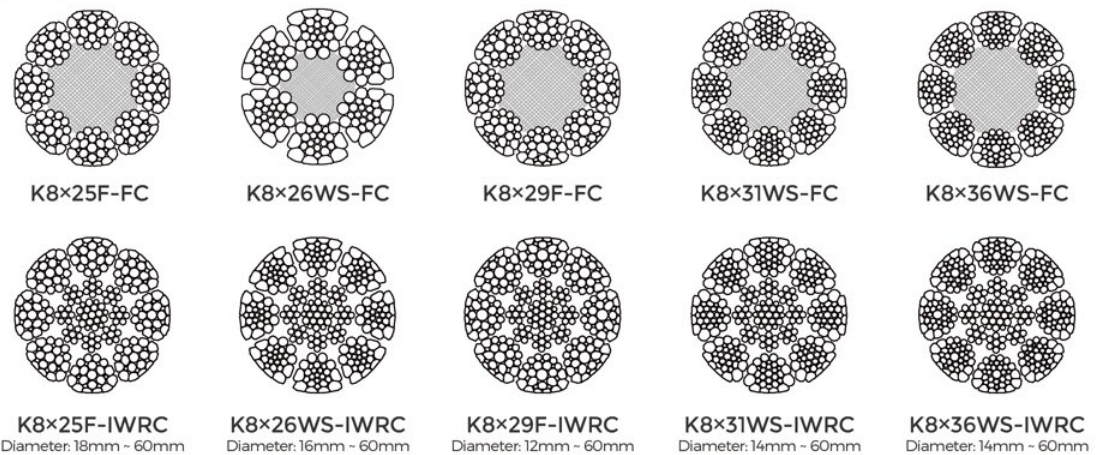
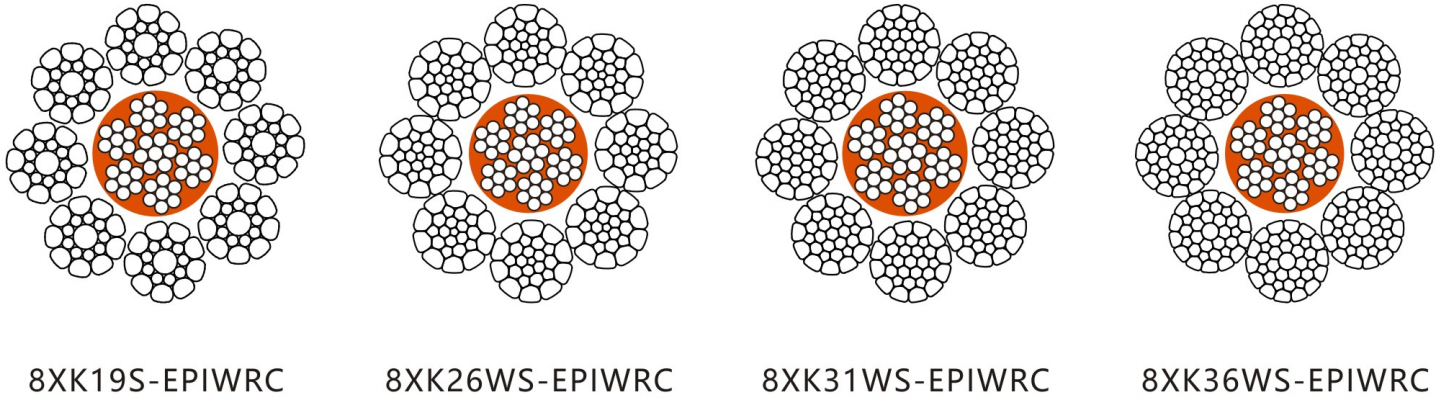
A round strand wire rope consists of three primary components: the wires, the strands, and the core. The individual steel wires form the basic unit of the rope. These wires are made of high-carbon steel, offering excellent tensile strength and fatigue resistance. The number, diameter, and arrangement of these wires affect the rope’s flexibility, strength, and abrasion resistance. The wires are then twisted into strands, usually with a round cross-section, and the strands are laid around the core.
How Is the Rope Built From Wires to Strands to Rope?
The construction follows a simple hierarchy.
| Level | What It Is | Why It Matters |
|---|---|---|
| Wire | A single high-carbon steel wire | Sets the tensile strength and fatigue resistance |
| Strand | Wires twisted together, usually round | Sets the flexibility and the abrasion behaviour |
| Core | The centre of the rope | FC for flexibility, IWRC for strength |
| Rope | Strands laid around the core | Sets the lay length and the rotation behaviour |
What Are the Standard Strand Configurations?
6×19, 6×36, and 6×37 are common for general lifting and hoisting applications. 8×19 and 8×36 are typically used for heavier loads or specialized purposes. The first number is the number of strands. The second is the number of wires per strand.
The number of wires per strand is what decides the character of the rope. Fewer, thicker wires give a tougher rope that stands up to abrasion. More, thinner wires give a rope that bends better and resists fatigue. This is the trade-off that runs through the whole range.
| Construction | Wires Per Strand | Character | Best For |
|---|---|---|---|
| 6×19 | 19 | Tough, abrasion resistant | Heavy lifting, rough conditions |
| 6×36 | 36 | Flexible, fatigue resistant | Cranes, elevators, high cycle work |
| 6×37 | 37 | Flexible with extra fatigue life | High cycle lifting |
| 8×19 | 19 | Heavy duty | Very heavy loads, larger rope sizes |
| 8×36 | 36 | Heavy and flexible | Large diameter high cycle applications |
What Does the Twisting Direction Mean?
The twisting direction of the strands can be right-hand lay, Z-lay, or left-hand lay, S-lay. This influences the rope’s rotation and torque characteristics during operation. A conventional rope laid all in one direction will spin under load, which can be a problem on a free-hanging load. Where rotation matters, our non-rotating wire rope construction balances the lay lengths so the torque cancels out.
Why Is Round Strand Still the Most Used Wire Rope?
Four reasons, and they are all practical.
It is the cheapest way to make a rope that works. It is the most available, with the widest range of sizes and constructions in stock. It is the most flexible of the main constructions, which matters on small drums and tight sheave arrangements. And it is the easiest to specify, repair, and install, which means the crews working with it already know it.
| Factor | Round Strand | Compacted Strand | Shaped Strand |
|---|---|---|---|
| Purchase cost | Lowest | Higher | Higher |
| Availability | Widest range in stock | Limited to common sizes | Limited to common sizes |
| Flexibility | Highest | Good | Good |
| Strength at same diameter | Baseline | Higher | Higher |
| Fatigue resistance | Standard | Better | Better |
| Internal friction | Highest | Reduced | Lowest |
| Installation and repair | Simplest | Standard | Standard |
| Best value for | General lifting | High cycle and high load | Long life heavy duty |
When Is a Round Strand Rope the Right Choice?
A round strand rope is the right choice when the cycle count is moderate, the load is not extreme, the drum and sheave arrangement is generous, and the budget matters. It is also the right choice when you need a diameter that is not available in compacted or shaped form. In many cases it is simply the only thing the supplier has in stock, and a good rope available now beats a better rope in six weeks.
When Should You Step Up to a Better Construction?
Step up when the rope is failing from internal wear, when you are running a high cycle count, when you need more strength at a given diameter so you can reduce the rope size, or when the environment is wet and corrosive enough that the internal wires need the protection. Our compacted strand wire rope addresses the metal content and void problems, and our shaped strand wire rope addresses the internal friction problem.
What Are the Core Options and How Do You Choose?
The core is the centre of the rope, and it makes two big decisions.
A fiber core gives a flexible rope that handles small drums and tight sheaves well, but it has lower strength and lower abrasion resistance. An independent wire rope core, IWRC, adds strength and stiffness and resists crushing, which matters on heavy static duties where the rope is squeezed against the drum.
| Core Type | Strength | Flexibility | Crush Resistance | Best For |
|---|---|---|---|---|
| Fiber core (FC) | Lower | Highest | Low | Cranes, elevators, small drums |
| IWRC | Higher | Lower | High | Mine hoists, heavy static duties, winches |
When Does the Core Decide the Application?
If the rope is running over small sheaves and needs to be flexible, the fiber core wins even if the load is high. If the rope is running on a large drum under high tension and the drum layers are crushing it, the IWRC wins even if flexibility would have been nicer. The core is not a detail, it is a structural decision.
What Materials Are Used and How Do They Affect Performance?
The material decides how the rope handles the environment.
Carbon steel is the standard for lifting and industrial work. Galvanized steel provides corrosion resistance for outdoor or marine environments. Stainless steel is used in highly corrosive environments. Each step up in corrosion resistance costs more and changes the handling characteristics, because a softer corrosion-resistant material wears differently.
| Material | Corrosion Resistance | Typical Use |
|---|---|---|
| Carbon steel | Low | Indoor cranes, hoists, general industry |
| Galvanized steel | Good | Outdoor, marine, damp environments |
| Stainless steel | Excellent | Chemical and highly aggressive exposure |
How Do You Protect a Round Strand Rope in a Harsh Environment?
Two options, and they solve different problems. Plastic impregnation fills the spaces between the wires with a polymer compound, which stops internal corrosion and reduces friction. Plastic coating puts an extruded polymer layer around the outside of the rope, which protects against abrasion, corrosion, and chemical attack.
Impregnation protects the inside. Coating protects the outside. On a rope in a wet mine shaft, the internal wires are the ones that fail first, so impregnation is usually the better answer. On a dragline where the rope drags over rock, the outside takes the wear, so coating is the one that helps.
How Does a Round Strand Rope Compare With a Spiral Strand Rope?
A spiral strand rope is a different animal. Instead of being made of wires twisted into strands and then laid into a rope, it is made of individual round wires helically wound around a core, usually in opposing directions. The result is a rope with very high axial stiffness, an exceptional strength-to-weight ratio, and a torque-balanced design.
Where a round strand rope bends easily and accepts repeated flexing, a spiral strand rope wants to stay straight. It is built for high axial load over long lengths, not for cyclic bending. This is why spiral strand ropes are used for stay cables and tensioned structures, while a round strand rope is used for hoisting and lifting where the rope goes over sheaves all day.
The practical rule: if the rope bends around a sheave, use round strand. If the rope is a straight tension member, consider spiral strand. You can read the construction details on our spiral strand ropes page.
What Is the Practical Cost of the Round Strand Approach?
The honest answer is that a round strand rope carries less metal at a given diameter than a compacted one. This shows up as a lower breaking load for the same nominal size. In most applications this does not matter, because the design is driven by the working load and there is plenty of margin.
It matters in two situations. The first is a weight-sensitive installation, such as a crane on a small rig, where a lighter rope means a smaller crane. The second is a space-constrained one, such as a hoist with a limited drum, where a shorter rope saves turns of drum. In both of those cases, moving to a compacted construction can pay for itself immediately. Everywhere else, the round strand rope is the sensible answer.
How Do You Select a Round Strand Wire Rope?
Six checks, in order.
Start with the working load and the safety factor. Then the minimum breaking load, which comes from the diameter and the construction. Then the number of bending cycles, which decides between 6×19 and 6×36. Then the environment, which decides the material and the protection. Then the drum and sheave geometry, which sets the minimum sheave diameter. And finally the core type.
- Working load and the safety factor required by the applicable standard
- Minimum breaking load for the diameter and construction
- Bending cycles per shift, which decides 6×19 versus 6×36
- Environment: dry, damp, marine, or aggressive
- Drum diameter, sheave diameter, and the number of sheaves
- Core type: fiber core or IWRC
What Is the Minimum Sheave Diameter and Why Does It Matter?
The minimum sheave diameter is set by the construction and the rope diameter. A rope bent around a sheave that is too small develops high bending stress at the contact point, and the wires break from fatigue. Every construction has its own minimum, and the 6×36 range can run on a smaller sheave than the 6×19 at the same diameter because the individual wires are smaller and more flexible.
If the sheave diameter is fixed by the existing machine, this check can rule a construction out before anything else. It is worth doing first, because it costs nothing and it prevents the expensive mistake of ordering a rope that cannot safely run on the rig.
What About the Rope Terminations?
A rope is only as strong as its weakest end. The termination has to be matched to the rope diameter, the load, and the environment. Our swaged wire rope page covers the mechanical termination options. Whatever the termination, the rope specification and the certificate should both be read together, because a mismatch between them is the failure that gets blamed on the rope.
Conclusion
Round strand wire rope keeps the natural circular profile of its wires and strands. It is the most widely used rope in the world because it is affordable, available in every size, and the most flexible of the main constructions. Choose 6×19 for toughness, 6×36 for fatigue life, and a fiber core or IWRC to match the drum and the duty.